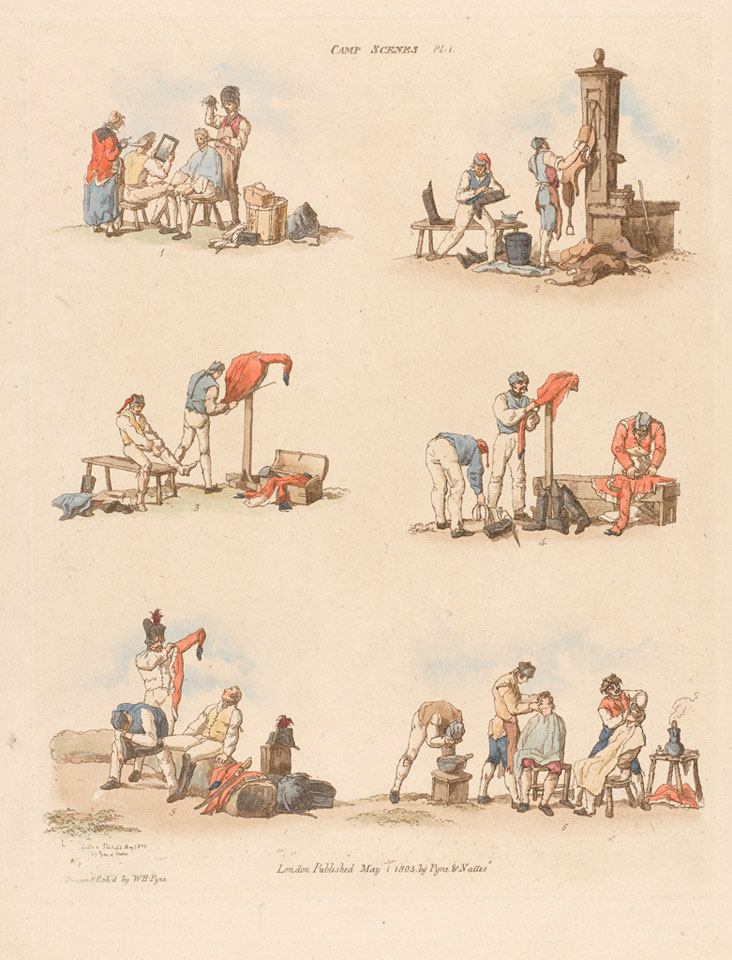
The Hostalric fortress was not designed to house a large contingent of soldiers, but the French War and the strategic importance of the square forced a considerable increase in its strength. From a few hundred they increased to more than two thousand during the siege of 1810.
A report by the engineer Carlos Francisco Cabrer, from 1809, noted the lack of space for the defenders, which forced them to take advantage of all kinds of spaces.
If the rooms allowed it, the soldiers were quartered by companies. Otherwise, by smaller units, like in this room where we are, where a squad lived – about 8 to 12 men. This was the smallest unit of troops and was commanded by a corporal.
Together they slept, ate, cooked, cleaned their weapons or repaired their clothes and equipment. Their few belongings were also kept here.
The corporal was directly responsible for his men. He had to worry about instructing them as soldiers, maintaining discipline and correct uniformity, maintaining weapons and equipment, distributing tasks and ensuring food. Any anomaly or fault had to be reported to his sergeant and failure to do so was punishable. Corporals were distinguished, among other things, by the wooden rod with which they were authorized to beat soldiers in the event of serious disobedience.
This writing from the “Prontuario” gives us information, not only about some of the obligations of the “corporal”, but also about the living space of the soldiers:
“The Corporal will ensure that the part of the Barracks belonging to his Squadron is kept in the cleanest condition, the weapons in the best possible order, the knapsacks hung up; that no nails are driven into the wall without the Captain’s permission; and that the tables, benches, jars, pots, lids, and other furniture are kept clean and well cared for.
The Corporal will oversee that his Squadron receives the firewood, beds, and oil to which it is entitled; that the sheets are changed every month, and that all the clothing delivered by the Provisions is acceptable.” (Prontuario, pág. 82)
A quartermaster and a rancher were designated daily to carry out service tasks. The “Prontuario” perfectly defines the obligations of both:
“(The quartermaster) will sweep the barracks where his company is located, will not allow any weapon to be taken out without permission from his officer, sergeant, or corporal, will prevent soldiers from engaging in prohibited games, and will ensure that no one takes clothing from a backpack or suitcase that is not his own, nor takes it out of the barracks without permission from the sergeant or corporal: he will ensure that the beds are made up at the appointed time, and that the lamps are not extinguished after being lit until dawn.” (Prontuario, pág. 9)
“(The ranger) must go to buy, in his linen jacket and garrison cap, what he needs for his morning and afternoon rations, which he will have ready at the appointed times. 2. It will be his obligation to deliver clean pots, lids, and other cookware used by the troops, as well as to extinguish the stoves.” (Prontuario, pág. 8)
The sergeants and officers slept and ate in separate rooms and were freed from all domestic work. It was common for them to even live outside the barracks, in houses in the village.
The sound of the drums marked the daily rhythm. Early morning, they played “diana” and the corporals made sure that everyone got up, took roll and checked that the soldiers washed their faces and hands. Once the room was tidy, the daily chores began.
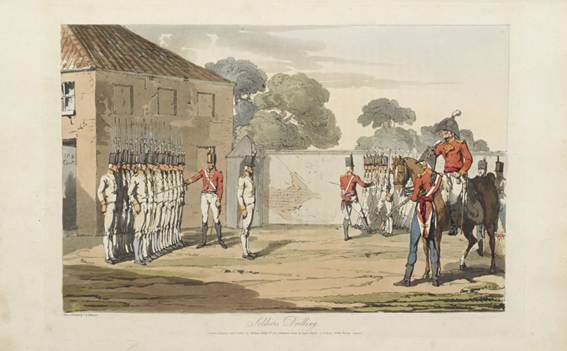
The soldiers who were assigned to guard duty or other duties left for their respective destinations. The rest gave instructions. In the way of fighting at the time, in closed and compact formations, precision in all movements was vital, and they practiced until they came out mechanically. Discipline was ironclad. In addition to the daily training at the barracks, marches and maneuvers in the field were added.
Twice a day they played “fagina”, indicating the two daily meals. One was in the morning, before starting the activities and the other in the afternoon. The “ranchers” had to worry that the food was ready at the appointed time.
The Spanish soldiers prayed twice a day:
“35 The (sergeant) who was assigned to the care of the Barracks, will gather the Company in the middle of the afternoon Roll Call to the Retreat, for the Rosary, without any mixing of singing in it, nor for joys, nor other prayers, because everything must be prayed with devotion and a reverent tone.” (Prontuario, pág. 225)
After the second meal of the day came leisure time. Either in the improvised canteens of the companies or in the taverns of the towns, the soldiers tried to “drown the sorrows” of the day, until the “retreat” bell sounded, when everyone – including officers on duty – had to be inside the barracks.