
“…to be exposed to the sun, rain, snow, wind, and dampness; to suffer excessive cold; to have wet clothes day and night; to get so hot that they sweat, and to suddenly get cold; to spend the whole night in the open air; to lie down on the ground, or on straw alone, most often wet; to go months without undressing or sleeping in a bed; to drink bad water and worse wine; to eat bread of poor quality, made with bad wheat, and poorly kneaded and baked, spoiled meat, and poor quality fruit and fish; to undertake marches and other strenuous exercises… and all of them to suffer constant fright… Nothing is more harmful to a man’s health than to suddenly go from a regular life and moderate work to an active, laborious, and unaccustomed one…” (Josep Anton Viader Payrachs, Girona 1810)

Who were these soldiers?
The regular army was fed, since the 18th century, by the “quintas” and the forced levies. From 1770 military service became compulsory with annual draws to obtain the necessary number of recruits. In Catalonia and the Basque Country this system was not fully implemented due to strong opposition from the population.
In 1800, a third of the soldiers came from the “quintas” but half were foreign volunteers on salary, and the rest was completed with the forced levies of vagrants, beggars and the unemployed.
The soldiers received a salary, but all expenses had to be deducted from this, ultimately leaving a meager pay.
The garrison of Hostalric around 1810 was made up of several regiments and smaller units. The most significant were the 2nd Terç de Miquelets from Girona, the Ultònia Regiment and the Lliberia Regiment, the latter from Granada. The Ultònia and the Lliberia were formed by regular soldiers. The Terç, by volunteers.
The Second Third of Miquelets of Girona was formed on May 15, 1808, with volunteers from the area at the initiative of the Girona Defence Board, which also uniformed and equipped them.
On June 20, 1808, the “Supreme Government Board of the Principality of Catalonia”, meeting in Lleida, ordered the formation of an active army of 40,000 miquelets, calling on all men aged 16 to 40 to join as volunteers, without exception of condition and preferring single men over married men, and widowers without children. (page.1). The recruits were entitled to uniform and equipment and, in theory, to a daily salary of 4 reals of “bitlló” and 2 pounds of bread.
But the call did not turn out as they had hoped and little more than half of the troops were recruited. In Girona, 2,142 recruits were incorporated out of the 5,911 that were expected, being distributed irregularly among the three “Terços” of the city.
It is complex to venture specific figures for the 2nd Terç of Miquelets of Girona, but according to the “Instituto de Historia y Cultura Militar”, at the beginning of June 1808 it had a force of 1,019 men, divided into two battalions. On October 16 of the same year, the 1st Battalion was part of the Hostalric garrison with a “boss”, 5 captains, 21 subalterns, 31 sergeants, 25 drummers and 456 corporals and soldiers. From May 6 to December 12, 1809, the Terç defended Girona until the capitulation.
These same men, with many casualties, also defended the fortress of Hostalric until May 12, 1810, when they escaped the French siege. Only 138 managed to reach Vic two days later.

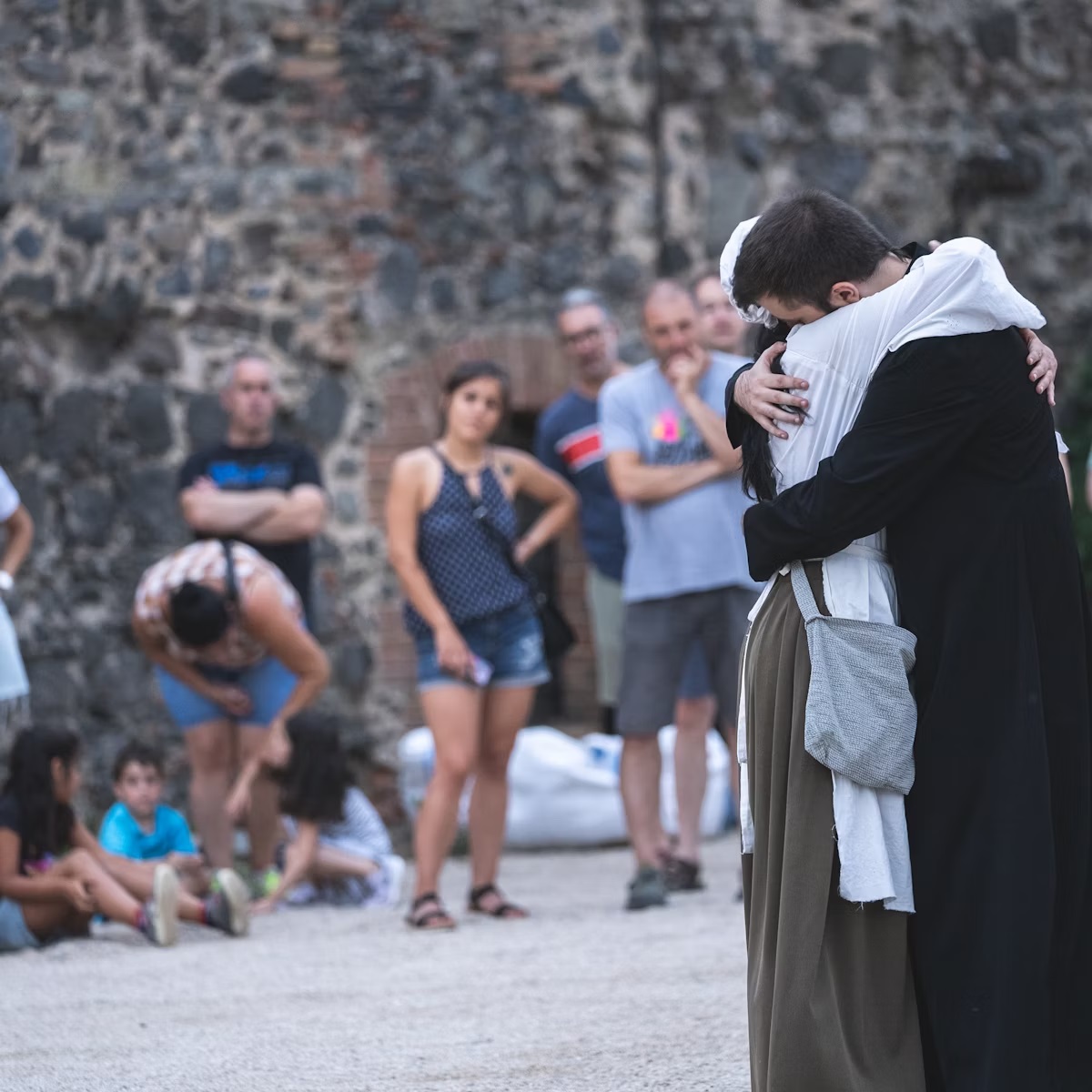
Recreator of the second Terç de Miquelets of Girona.
The Ultònia Infantry Regiment was a professional military unit formed at first mainly by Irish volunteers that served in the Spanish army between 1709 and 1818.
It was present in many of the wars in which Spain participated in the 18th century, both in Europe and overseas. The losses due to age or in combat, as well as the aggregation of other units and the numerous destinations, led to a gradual decrease in the Irish origin among the troops, although it was maintained among the officers. When they were assigned to Girona in 1804, few soldiers understood Gaelic or English.
Between 1808 and 1810, the regiment’s strength was very small. When they participated in the defence of Girona in the three sieges, they must have consisted of between 300 and 400 soldiers and were the main regular force of these exploits.
Captain Daniel O’Sullivan of Ultònia appears as interim governor of the fortress in documents signed by him between June and December 1808. He commanded the defence of Hostalric at the end of July 1808, facing a small detachment of his regiment (about 180 men), 31 artillery pieces (with 15 gunners and 110 servants) and units of miquelets from Hostalric and Vic, against an attack by about three to four thousand French soldiers, with artillery and cavalry.
In 1809, Colonel Enrique O’Donnell was appointed commander of the regiment, but he did not remain in the fortress of Hostalric, as he left to supply besieged Girona and was unable to return. O’Donnell would become the captain general of Catalonia.

Plate with soldiers and flag of the Ultònia Regiment. Drawing by Joaquim Pla i Dalmau. Private collection, Girona.
The Lliberia Infantry Regiment (Roman name for Granada) was formed in 1808, with part of the Granada Regiment and the Jaén Volunteers, and in November of the same year it passed to the Army of Catalonia. On September 6, 1809, they arrived in Hostalric, where the 2nd battalion remained as a garrison. In January 1810 it had about 2000 men. Its commander, Julián Estrada became the military governor of the place and commanded the defence against the French, as well as the final evacuation.
On May 11, the French Marshal Augerau had sent them an ultimatum, offering an honourable capitulation “like that of Girona”, or all be put to death. Estrada replied:
“Sir Marshal: I thank you on behalf of the garrison for the comparison you have deigned to make with that of the immortal Girona. However, I do not accept your proposals, as I am not in a position to surrender. Julián de Estrada”.
On the night of May 12, 1810, after 4 months of siege and heroic defence of the fortress, without a water supply and faced with the impossibility of receiving reinforcements, Estrada and approximately a thousand of his soldiers managed to escape the siege. They were surrounded by about 8,000 of Bonaparte’s men. Estrada divided his soldiers into three groups, to increase the chances of success. On the one hand, the wounded, who remained in the fortress, providing cover for their comrades. On the other, two contingents, who managed to escape from their besiegers at first. The 400 men who formed the rearguard group, as well as Colonel Estrada – who was seriously wounded, – were taken prisoner the next day. But the vanguard contingent, made up of about 700 soldiers, managed to reach Vic and join General O’Donnell’s forces.
Apart from the three units detailed, there was a considerable number of others that passed through Hostalric between 1808 and 1810, both infantry and artillery or cavalry. Some came from far away, such as the Santa Fe Infantry Regiment, the Almansa Volunteers, the Royal Hussars of Granada or the First Santiago Cavalry Regiment. Others from Catalonia, such as the Tarragona Volunteer Battalion, or the Terç de Miquelets of Vic.
But when the Spanish troops left, the fortress was not empty. Then it was the turn of the French soldiers and their allies, who would remain in Hostalric until June 4, 1814. Other armies, other commands, but, in short, young men, far from home and family, fighting in a bloody war, like all wars.